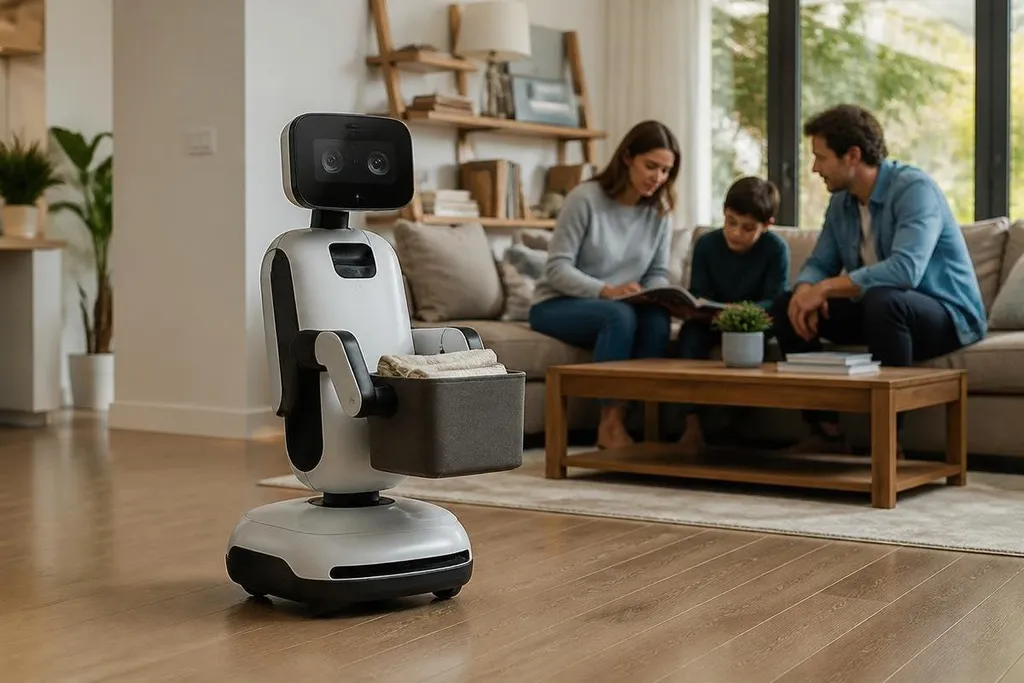
A home robot has to do more than move, speak, or follow a person around. It has to work safely near people, understand simple requests, and keep doing useful tasks after the demo ends.
- Better conversation means little if the robot forgets the task five minutes later.
- A useful companion needs clear limits around cameras, microphones, and stored data.
- The hardest test is repeated daily work inside a real home.
What a companion robot must do
A companion robot sits between a household appliance and a mobile computer. It may use cameras, microphones, touch sensors, wheels, or legs to read the space around it.
Those parts matter because the robot needs to act without bumping into furniture, people, or pets. Movement alone doesn't make the robot useful.
It needs a task that fits the home, such as carrying a small item, checking a room, reminding someone about a routine, or connecting a person with remote help. Each task also needs a clear stopping point when the robot is unsure.
That last part separates a working system from a polished demonstration. When the system cannot identify an object, asking for help is safer than continuing with a guess.
Conversation is only one layer
Speech gets attention because people can see the result at once. A person asks a question, and the robot answers. The harder work starts after that exchange, when the system must remember the request, connect it to the room, and act on it.
A useful robot needs more than a language model. It needs software that links speech to perception and motion. “Bring the cup from the table” requires the robot to find the table, identify the cup, plan a route, and handle an object without breaking it.
Memory brings another limit. A robot may need to remember a person’s name or a preferred routine, but storing every conversation creates a privacy problem. The maker needs to explain what stays on the robot, what leaves the home, and how the owner can delete it.
Privacy claims need a record of what the robot stores and sends. Robot24.com robotics reporting adds context from named systems and real tests before the article turns to the quiet bottleneck: making companion robots useful every day.
The global race has a quiet bottleneck
Companies in several countries are working on robots for homes, care settings, and social use. Their designs may differ, but the hard problems are similar: reliable perception, safe motion, battery life, repair, and cost.
The system can speak for hours while its battery lasts only part of a day. It can recognize a clean table in a test room and fail when sunlight, clutter, or a pet changes the scene. These limits affect daily use more than a long feature list does.
The home also has no fixed layout. A factory can mark walking lanes and place parts in set positions. Room layouts vary, so the robot must handle narrow paths, loose cables, stairs, and objects left on the floor.
What buyers should check
Marketing pages often describe the robot’s intended role. A buyer needs evidence for the work the robot can do now. Check these points before paying a deposit or planning a home trial:
- Task proof: Find an uncut video or independent test of the exact task you need.
- Human control: Check how you stop the robot, take over, and recover from a failed action.
- Data handling: Ask where video, audio, maps, and account details are stored.
- Home fit: Measure door widths, floor changes, stairs, and the space around furniture.
- Service plan: Confirm repair options, software support, replacement parts, and return terms.
These checks also help compare different designs. A robot that performs one useful task every day may serve a household better than a more complex model that needs frequent help.
What happens next
The next useful proof will come from long home trials, not short stage clips. Buyers need results from ordinary rooms, with repeated tasks, blocked paths, low batteries, and clear records of when a person had to step in.
I'd wait for makers to publish that kind of evidence before treating a companion robot as a household purchase. Until then, the sensible target is a narrow job with a clear safety plan, not a machine expected to understand the whole home.